
Forty-one. That's how many consecutive EuroMillions draws one particular main number sat out before it reappeared on the frequency chart I keep, and forty-one is exactly the kind of gap that gets a number called 'overdue' by every forum thread and lottery blog except the machine that actually draws it. I teach maths for a living and spend a fair bit of spare time on lottery probability, comparing my own EuroMillions analysis against a couple of AI prediction tools on the side, and hot and cold numbers are the question I get asked about more than almost anything else. The honest answer sits somewhere between 'no' and 'sort of, but not for the reason you'd think.'
What Counts as Hot? What Counts as Cold?
A 'hot' number, in most players' shorthand, is one that's shown up more than its fair share lately — three appearances in ten draws, say, instead of the roughly one you'd expect from a pool running 1 to 50. A 'cold' number is the opposite: it's gone quiet for weeks, sometimes months, and the silence itself starts to feel meaningful. Neither label describes anything about the future. Both describe a small slice of the past, and small slices of a random process are lumpier than most people expect — which is exactly where the trouble starts.
The Gambler's Fallacy and the Myth of the 'Due' Number
Flip a coin four times and land on heads every time — unlikely, but not impossible — and plenty of people will insist tails is 'due' on the fifth flip. It isn't. The coin has no memory of the previous four tosses; every flip belongs to a set of independent events, and the fifth is still a plain fifty-fifty split. EuroMillions runs on the same principle, just with more balls and a bigger machine. The draw itself is a statistically independent event: last Tuesday's result has no mathematical influence on next Friday's, whatever a frequency chart seems to suggest.
This is the exact shape of the Gambler's Fallacy: assuming that because the main pool of 1 to 50 (plus a Lucky Star pool of 1 to 12) should balance out eventually, any specific ticket is owed a correction now. Over thousands of years of draws, the numbers probably would even out. That fact does nothing for next Friday's ticket, where the odds of any one main number reset completely every single time, regardless of what happened last week or last month.
Reading a Frequency Chart Without Fooling Yourself
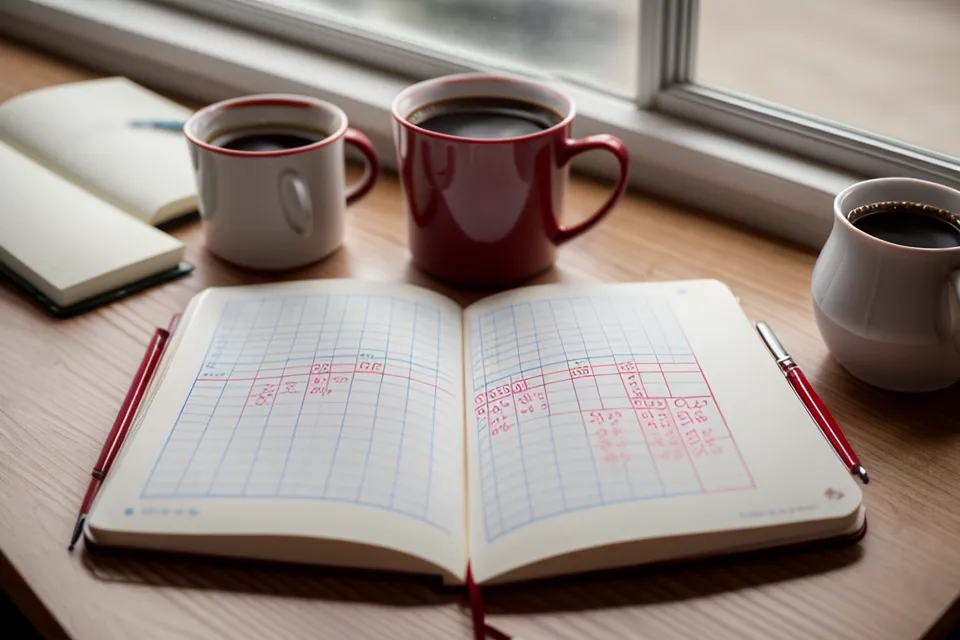
Mine lives on the wall of a spare room in Didsbury that's ended up doubling as a study — a folding desk under a window that only ever catches flat, north-facing light, two screens side by side (the draw database on one, whatever I'm writing on the other), and the paper chart getting a fresh red-pen mark after every draw, with the tea beside the keyboard going cold more often than not. None of that setup makes the chart predictive. It just makes a pattern easier to see, which is a different thing entirely.
One app I tried for a stretch promised to flag numbers that were 'overdue' for a reappearance, which turned out to be the same myth wearing a nicer interface. I deleted it within a fortnight once its 'insights' revealed themselves as repackaged versions of exactly the misunderstanding I've just described.
What actually changed how I read my own chart was smaller and stranger than any app. I remember standing at the terminal in the corner shop near where I live, watching a quick pick spit out two numbers that were already circled on my frequency chart at home for showing up more than they should, and realising that a coincidence like that tells you far less than it feels like it does in the moment.
Neville Ashworth, one of the readers who follows this closely, keeps his own results in a paper ledger — he's a retired civil engineer from near Wigan — and occasionally sends handwritten notes that turn up about a week after each draw, his own tally circled twice for emphasis. He isn't wrong to track things by hand; writing every draw down forces you to look at data instead of vibes. The mistake would be turning that discipline into a forecast, rather than treating it as just a record of what already happened.
Whether AI tools are doing anything more sophisticated than very fast counting is a question worth asking on its own, and one I've picked apart in more detail elsewhere. For hot and cold numbers specifically, the honest answer is that they're mostly just counting — faster, and across more draws, than I could manage by hand. Zainab, a university friend who now writes software for a living, looked over the scraping script behind one of these tools for me once and pronounced it competent but unremarkable. She still won't buy a ticket herself, on principle, which I've come to respect more than I probably let on.
Does the Machine Have Any Physical Bias at All?
Here's the thing though: I don't think the answer is a flat no, which tends to surprise people who expect a maths teacher to be tidy about this. In a perfect textbook, every ball is an identical sphere and every machine behaves like an idealised random number generator. Real machines are physical objects, with paint, wear, and moving parts, and physical objects are never quite perfectly uniform.

What that means in practice is considerably less dramatic than it sounds. If a microscopic difference in a ball's paint or a faint scuff on its surface nudges its odds at all, the effect is almost certainly too small to notice over a normal player's lifetime of tickets, let alone to use. Lottery operators also test and rotate their equipment specifically to catch this kind of drift before it becomes visible. So while I won't claim the machine is a perfect mathematical abstraction, I also won't pretend that spotting a 'hot' number hands you a working strategy — the gap between 'theoretically not quite random' and 'therefore I can win more' is enormous, and most hot-numbers advice online quietly skips over it. I've written more on this in how I filter lottery defeated picks using Manchester math principles, which is really just a longer answer to the same question: how do you tell a real signal from noise dressed up as one.
Hot and Cold Aren't the Only Patterns Worth Questioning
Hot and cold numbers aren't the only pattern players read into a random process — birthday combinations and 'balanced' tickets fall into much the same trap, and I've picked apart why elsewhere rather than repeating the whole argument here. None of this touches whether a ticket is worth its price in the first place, either. That's a separate calculation involving jackpot size and odds together, and I've covered it on its own rather than folding it into this piece.
A Frequency Chart Earns Its Keep as a Record, Not a Forecast
None of this means frequency charts are useless — they're just not predictive in the way people want them to be. A chart earns its keep as a record, a way of checking whether a claimed pattern is genuinely unusual or just the ordinary lumpiness of small numbers. If a number has skipped forty draws, that's mildly interesting as trivia; treating it as a signal to bet more, or differently, is where the mistake happens, not in keeping the chart itself. For the fuller comparison between manual tracking and AI-assisted tools, I've set out the results in The Teacher’s Notebook: 6 Months of Testing AI Against the EuroMillions, without repeating that whole account here.
Right then — the practical version of all this: don't buy a ticket, or skip one, because a number looks 'overdue.' Do use a chart, if you enjoy that sort of thing, to check whether a supposed pattern is actually rare or just an ordinary blip. Every EuroMillions draw resets to the same odds regardless of what the balls did last week, and that's not a disappointing answer so much as an honest one. It's also the one place where a maths teacher in Manchester and anyone else holding a ticket are, mathematically speaking, exactly equal.